About Artificial Grass Of Houston
Design-first turf planning for Houston's dense residential neighborhoods and surrounding markets.
Artificial Grass of Houston works across inner-Loop neighborhoods, established suburbs, and flood-adjacent communities where turf installation requires more than a standard spec-sheet build.
How We Work
Turf planning built around site conditions, not catalog defaults.
The inner-Loop neighborhoods and Houston suburbs where we work most often have conditions that a one-size-fits-all turf spec cannot handle well.
Artificial Grass of Houston focuses on synthetic grass systems for Houston properties where the site has a real set of constraints — a pier-and-beam foundation that limits base excavation depth near the structure, a heritage live oak whose drip line covers half the backyard, a rear grade that slopes toward the house instead of away from it, or an HOA covenant that specifies pile height and color range for front-yard installations.
The Heights, Montrose, Eastwood, Riverside Terrace, Garden Oaks, Oak Forest, Timbergrove, and Lazybrook are inner-Loop neighborhoods where lots typically run 5,000 to 7,500 square feet. On those properties, the space between the back of the house and the rear fence is often 30 to 50 feet, with a heritage tree eating up some of that footprint and a wood privacy fence on three sides limiting airflow. Every design decision — grain direction, seam location, border cut, drainage grade, infill type — happens inside a tighter space with less room for mistakes than a suburban flat lot.
We also work regularly in Katy, Cypress, Spring, Pearland, League City, The Woodlands, and other markets around the Houston metro where the soil profile, drainage behavior, and HOA governance create a different set of constraints than inner-Loop projects. The approach is the same: visit the site, understand how the space is used, build the specification around those conditions, and finish the installation with details that hold up visually and functionally over time.
Artificial Grass of Houston installs residential lawns, pet areas, playground surfaces, putting greens, backyard entertainment zones, and select commercial landscapes. The work spans front yards visible from the street to side yards used exclusively by dogs, and the design standard we hold ourselves to across all of those applications is the same: the finished surface should look like it belongs there and perform the way it was specified to perform.
Design Philosophy
The principles that shape how we plan and install every project.
These are the standards we hold on every job, whether it is a tight inner-Loop backyard or a larger suburban property in Fort Bend County.
Use drives the specification
A front yard on a 1940s bungalow lot in Garden Oaks is not the same project as a pet run in a Montrose side yard or a backyard putting green in River Oaks. The product selection, base depth, infill system, and edge detail should all follow from how the space is actually used — not from what is cheapest to install or fastest to deliver.
The base is the product
Houston's Beaumont clay expands and contracts with every rain cycle and dry spell. A turf installation that ignores that soil behavior will develop uneven surfaces, edge lifting, and drainage problems within three seasons. Artificial Grass of Houston treats base preparation as the core technical work of every project — aggregate selection, compaction in lifts, grade verification, and sub-drain routing where the natural site grade does not move water away from the turf area on its own.
The finish has to look designed
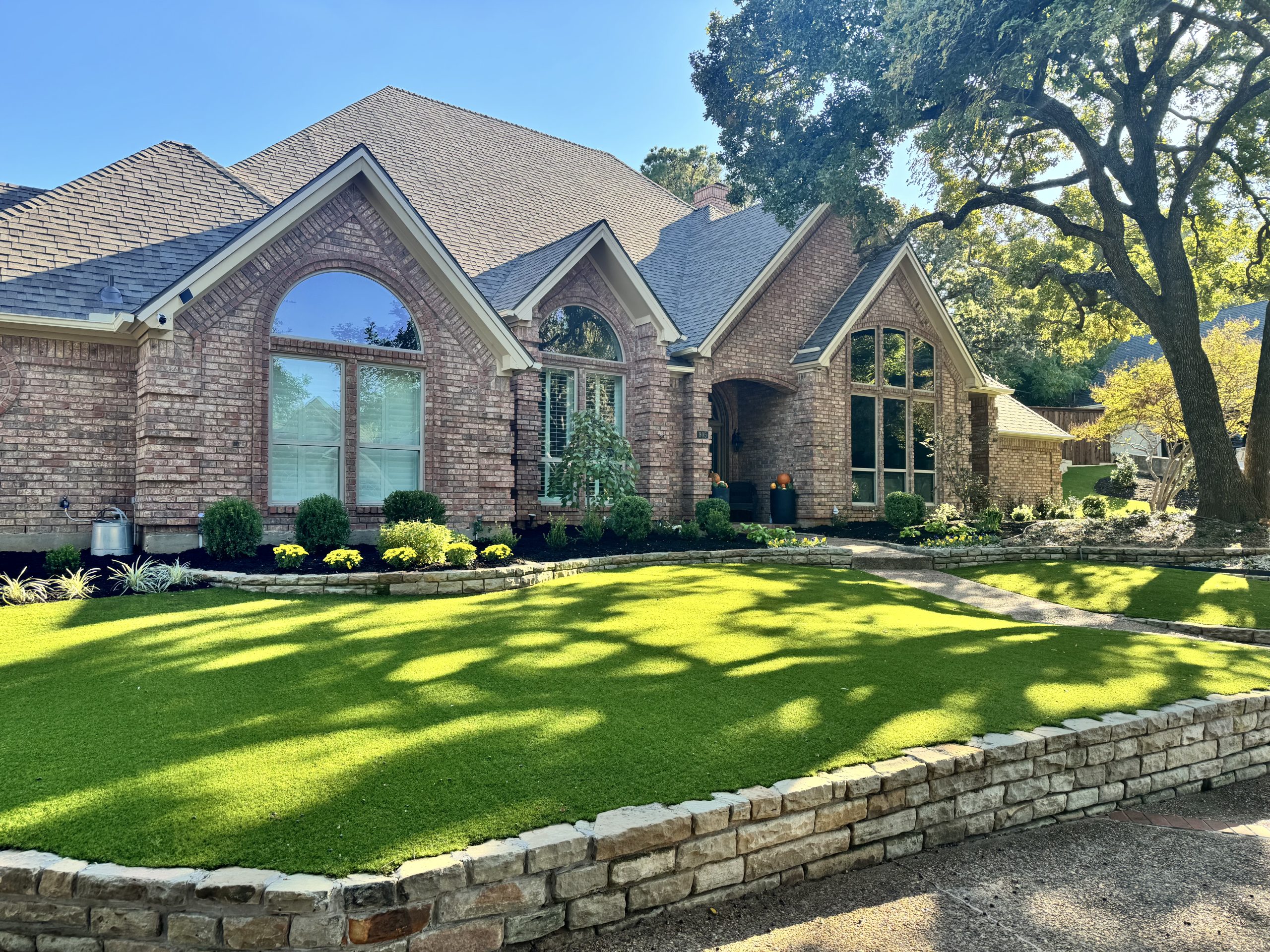
Edge transitions, grain direction, seam placement, and border integration with hardscape are the details that separate an installation that looks professional from one that looks like carpet dropped on soil. On inner-Loop properties where front yards are small and visible from the street, or on estate lots in Memorial where the landscape architect has already set a visual standard, those details are not optional.
Installation Process
How a project moves from first call to finished surface.
Every installation follows the same structured process regardless of project size, because the steps that get skipped early are always the ones that cause problems later.
Site-Specific Factors
What makes Houston turf planning different from a generic install.
Houston's urban and suburban geography creates turf installation conditions that differ from most other markets. The City of Houston's Heritage Tree Ordinance protects live oaks, water oaks, and other native trees above a defined trunk diameter — any excavation within the drip line of a protected tree requires a plan that does not compact the root zone or cut through major lateral roots. Artificial Grass of Houston accounts for protected trees in every layout plan and adjusts base depth and aggregate type near drip lines accordingly.
Houston's pier-and-beam housing stock, concentrated heavily in the inner Loop, adds another constraint. Pier footings extend from 12 to 36 inches below grade depending on age and design, and base excavation that hits a footing creates both a structural issue and a drainage dead zone. We document pier locations during the site visit and keep base work at a safe distance from any footing or crawl-space access point.
The 1100-year flood events on Brays Bayou and Buffalo Bayou have reshaped how Houston homeowners think about standing water. Properties adjacent to bayou floodplains — in Meyerland, East End, Lazybrook, and parts of the Heights — need turf drainage systems built for saturation events that exceed what the municipal stormwater system can handle in real time. For those properties, sub-surface French drain lines are not optional; they are the difference between a yard that recovers in hours and one that stays waterlogged for days.
Hard water from Houston Public Works, which draws from surface sources including Lake Houston and Lake Conroe, leaves calcium deposits on any surface that gets regular hose rinsing. For pet areas and playground turf maintained with frequent water contact, we recommend periodic citric acid rinses as part of the maintenance protocol to prevent mineral buildup that can affect infill performance and fiber appearance over time.
Warranty and Support
What comes with every Artificial Grass of Houston installation.
Every installation includes a workmanship warranty covering seam integrity, edge anchoring, drainage performance, and surface levelness. The turf products we install carry manufacturer warranties ranging from eight to fifteen years depending on product line and application type — sports turf carries a different warranty structure than landscape turf or pet turf.
Warranty terms are documented at project handoff along with the product specification sheet, care and maintenance schedule, and contact information for warranty service requests. We do not route warranty calls through a national call center — service requests for Houston installations are handled directly.
Post-installation support includes scheduled maintenance programs for clients who want ongoing care, repair services for seam or edge issues that develop after installation, and infill topdress service for pet areas where zeolite capacity degrades after twelve to eighteen months of use. We also offer a one-year inspection visit for new installations — a walkthrough to check seam condition, edge stability, drainage performance, and infill depth before any warranty issue becomes a significant repair.
Service Area
We serve Houston and the surrounding communities where turf planning comes up most often.
The markets below represent our regular service area. Reach out if your property is in a nearby community not listed — we work across the broader Greater Houston metro.
What Clients Usually Ask
Which turf product fits the way this space is actually used — not just the way it looks in a brochure?
How should drainage and base prep be handled for this specific property type, soil condition, and drainage path?
What should the turf connect into at the borders — the sidewalk, the pool coping, the planting bed, the patio edge?
Are there protected trees, HOA restrictions, or foundation constraints that affect what we can install and how deep we can excavate?
What maintenance does the finished surface actually need, and how does that change if there are pets or heavy family use?